Multi-Shot Direction on the Seedance Family: Preview Notes
Named shot beats, cut verbs, and continuity hints land on Seedance 2.0 today. Whether Seedance 2 Mini preserves that grammar at lower cost is a preview question, not a promise.
Multi shot prompting on Seedance 2.0 works. It does not work the way most beginners write it. The model reads cut scene language, named shot beats, and continuity hints in a specific grammar. Veer outside it and you get one take with confused pacing instead of three discrete shots.
Here is the grammar that lands, the grammar that breaks, and notes on whether it carries to Mini.
Why multi shot is hard at all
A 10 second clip is one continuous attention budget. The model picks a tempo, a camera, and a subject, and rides them across the duration. Ask for three shots inside that budget and it has to allocate roughly three seconds per shot and pick three coherent cameras for the same scene.
The default failure mode is averaging. You wanted a wide, a medium, a close. You got a long dolly that crosses all three framings without committing to any. The fix is naming the cuts explicitly.
The grammar that lands
Four conventions the model reads cleanly:
- Named shot beats with explicit cut language. Write "shot one: wide establishing, shot two: medium two shot, shot three: close on the hands". The phrase "shot two" tells the model to commit to a cut. Without that label, it averages.
- Cut transition verbs. Words like "cut to", "match cut on", "hard cut" are read as edit instructions. The model inserts a frame boundary where you put them. Soft transitions like "then" or "and" are read as continuous motion.
- Continuity hints on the recurring element. If a prop or person appears in two shots, name it both times. "The red mug in shot one returns in shot three on the table" tells the model to preserve the prop's identity across the cut. Without that hint, props mutate.
- A target shot count. Three shots in 9 seconds works. Four in 9 is the upper bound and only if the shots are short. Five collapses back into averaging.
A good prompt
"Three shot sequence over 9 seconds. Shot one (3s): wide establishing, a quiet diner at dawn, one waitress wiping a counter, warm tungsten practicals. Cut to shot two (3s): medium on the waitress pouring coffee into a white mug. Match cut on the mug to shot three (3s): close on the steam rising from the same white mug, soft morning light."
What this prompt does right: named beats, durations, hard cuts called out, and the white mug continuity bridges shots two and three.
A broken prompt
"A waitress in a diner at dawn wipes the counter, then pours coffee, then we see the steam rising from the mug, all warm and quiet."
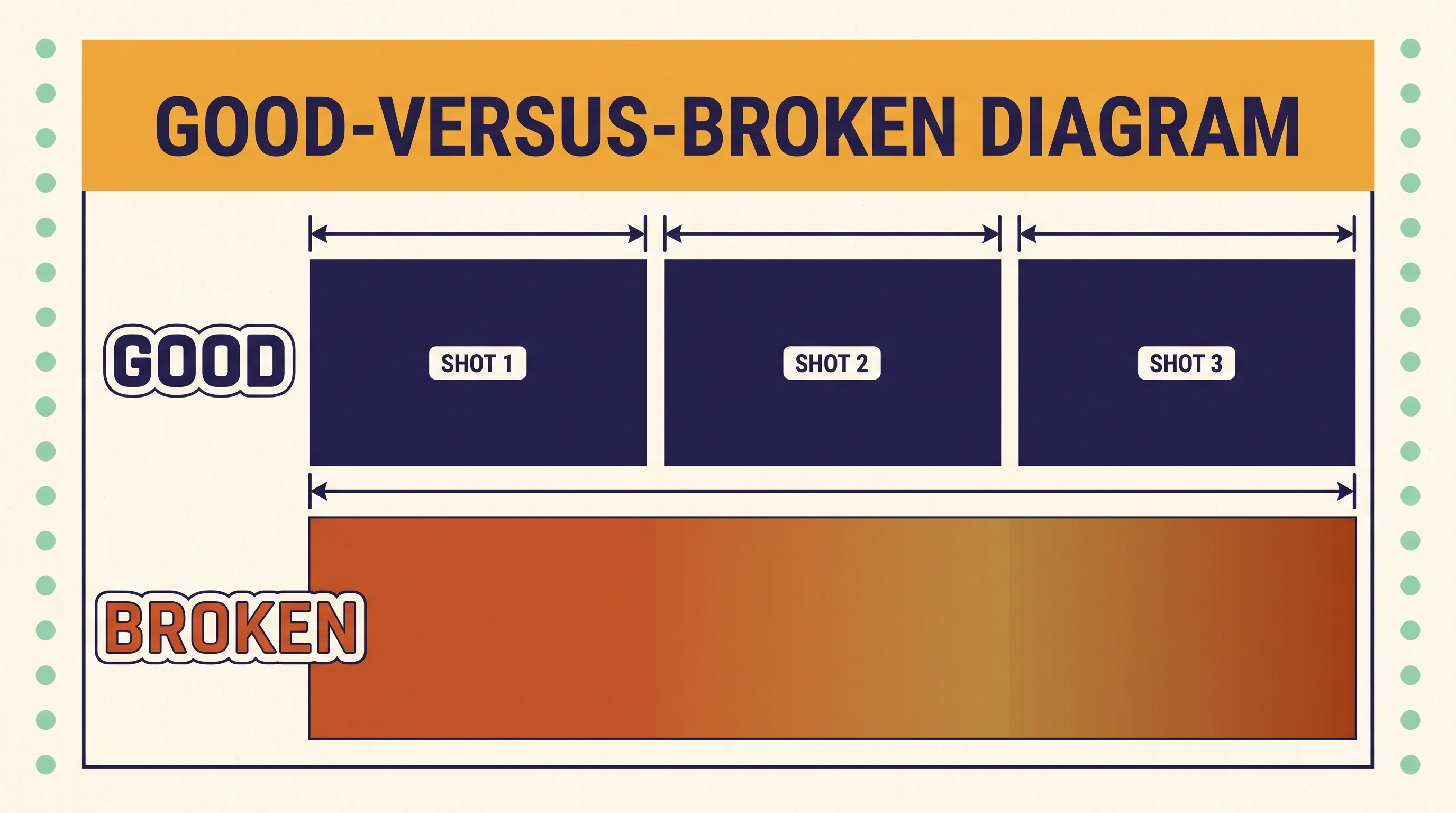 Same scene, no shot grammar. The model reads this as one continuous take. You get a 9 second dolly that drifts across the diner without ever committing to a wide, a medium, or a close. The mug appears once because there is no cut to bring it back.
A working multi shot call
01import { fal } from "@fal-ai/client";0203// Three shot sequence on Seedance 2.0 today.04const result = await fal.subscribe("bytedance/seedance-2.0/text-to-video", {05 input: {06 prompt: "Three shot sequence over 9 seconds. Shot one (3s): wide establishing, a quiet diner at dawn. Cut to shot two (3s): medium on the waitress pouring coffee. Match cut on the mug to shot three (3s): close on steam rising.",07 resolution: "720p",08 duration: 9,09 aspect_ratio: "16:9",10 generate_audio: true11 },12 logs: true13});1415console.log(result.data.video.url);
Cost on Seedance 2.0 today: 9 seconds at $0.3034 is $2.73 per take. Multi shot rarely lands on the first try, so budget 3 to 5 takes per sequence, $9 to $14.
Preview notes on Mini
Honestly: Mini is in preview and the spec sheet is not public. Cautiously: smaller models in a family tend to compress training signal toward common cinematographic patterns. Cuts, named beats, and continuity prop language are common patterns. If Mini preserves them, the grammar above carries. If Mini drops them, multi shot becomes a stitched workflow rather than a single call.
Either way, write this grammar today. If Mini honors it, you save on iteration. If Mini does not, you fall back to a per shot call and stitch in post.
Practical advice while you wait
Three shots is the practical ceiling. If you need more, render two 9 second sequences and cut them together. The seam is invisible when lighting and palette match across both prompts.
Write the shot list in plain English first, then translate to the named beat grammar. Producers read shot lists, models read grammar. You need both documents to ship.